

DC Valuation Punjab, DC Rate, E-Stamp & Property Tax: The Complete 2025 Guide
If you have ever bought, sold, or transferred property in Punjab, Pakistan, you have almost certainly heard the terms DC valuation, DC rate, e-stamp, and property tax thrown around at the registrar’s office or by your lawyer. Most people nod along without fully understanding what each term means, how they connect, and — most importantly — how they directly affect the amount of money that leaves your pocket.
This guide breaks it all down in plain language, drawing on the official Punjab government portals and the Board of Revenue’s published guidelines, so you can walk into any property transaction fully prepared.
What Is DC Valuation in Punjab?
DC Valuation stands for District Collector Valuation. It is the official minimum value that the Government of Punjab assigns to every piece of immovable property — plots, houses, flats, and agricultural land — across all districts of the province.
Think of it as the government’s floor price for any property. Even if you and the buyer agree to a deal lower than this figure on paper, the government will still compute all taxes and duties based on the DC value. You cannot go below it; you can only declare a value equal to or higher than the DC rate.
The DC valuation system was introduced to bring uniformity and transparency to property transactions and to prevent the chronic under-declaration of sale prices that historically allowed both buyers and sellers to evade their tax obligations. Today, DC valuation is the backbone of how stamp duty, Capital Value Tax (CVT), mutation fee, and registration fee are calculated in Punjab.
What Factors Determine the DC Value of a Property?
The DC value is not a single flat figure for an entire city. It is highly granular and depends on several variables, including:
- District (e.g., Lahore, Rawalpindi, Faisalabad, Multan)
- Tehsil (sub-district administrative unit)
- City or Town
- Revenue Circle (the local land revenue jurisdiction)
- Property Floor Type — whether it is a bare plot, constructed house, apartment, commercial unit, or agricultural land
- Land Classification — residential vs. commercial, urban vs. rural
- Property Area — measured in Marla, Kanal, or square feet
Each unique combination of these factors produces a specific DC rate per Marla (or per square yard/foot), and that rate is used to calculate the total DC value of the property.
DC Rate Punjab: How It Works and Why It Matters
The DC Rate is the per-unit price (typically per Marla) set by the District Collector for a specific locality and property type. The Punjab Revenue Department updates these rates periodically to reflect changes in market conditions.
The DC rate matters because it directly determines four key charges on every property transaction:
1. Stamp Duty — The provincial government charges stamp duty on the DC-evaluated value or the declared transaction price, whichever is higher. For urban properties, stamp duty is typically 1% of the DC-evaluated value; for rural properties it is 3%.
2. Capital Value Tax (CVT) — A tax applied on property transactions, also calculated based on the DC value.
3. Registration Fee — Charged at the time of property registration at the Sub-Registrar’s office.
4. Mutation Fee — Paid when ownership is formally transferred in the land records.
DC Rate vs. FBR Rate: What Is the Difference?
Many property buyers in Punjab are confused by the existence of two parallel valuation systems. Here is the key distinction:
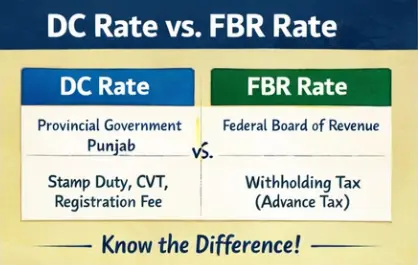
| Feature | DC Rate | FBR Rate |
|---|---|---|
| Set by | Provincial Government (Punjab) | Federal Government (FBR) |
| Used to calculate | Stamp duty, CVT, registration fee, mutation fee | Withholding Tax (advance tax on property) |
| Generally lower or higher? | Generally lower | Generally higher |
| Updated by | Revenue Department, Punjab | Federal Board of Revenue |
In practical terms, you pay stamp duty based on DC valuation, but you calculate advance/withholding tax on the FBR rate. Both systems must be accounted for in any property transaction, which is why working with a knowledgeable property lawyer or consultant matters.
E-Stamp Punjab: Replacing the Old Stamp Paper System
For decades, property transactions in Pakistan relied on physical, non-judicial stamp papers purchased from Treasury offices or licensed stamp vendors. The process was slow, opaque, and — critically — wide open to fraud. Counterfeit stamp papers were a documented problem that caused enormous legal complications for property owners.
The Government of Punjab, through the Punjab Information Technology Board (PITB) and the Board of Revenue, introduced the e-stamp system to fix exactly these problems. The e-stamp Punjab system is now the standard method for paying stamp duty on property transactions and legal documents across the province.
What Is Punjab E-Stamp?
Punjab e-stamp (also written as estamp, estamping, or e-stamp paper Punjab) is a computer-generated, digitally signed stamp certificate issued through the official Punjab e-stamping portal. It replaces the physical stamp paper entirely for high-value transactions and is accepted in all courts, government offices, sub-registrar offices, housing authorities, and financial institutions across Pakistan.
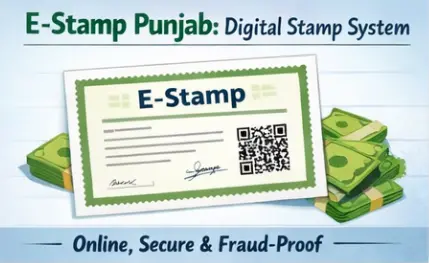
Key features of the Punjab e-stamp system include:
- A unique transaction ID for every e-stamp certificate
- QR code verification that anyone can scan to confirm authenticity
- Integration with the NADRA database for real-time CNIC verification of buyer and seller
- Automatic stamp duty calculation based on DC valuation tables built into the system
- 24/7 online accessibility through the official portal at es.punjab.gov.pk
- Elimination of fake stamp papers — once used, a stamp is marked in the central database and cannot be reused
What Documents Require an E-Stamp in Punjab?
The e-stamp system is mandatory or strongly recommended for:
- Property sale and purchase deeds
- Gift deeds and transfer deeds
- Mortgage and loan agreements
- Lease agreements above certain threshold values
- Power of attorney documents
- Affidavits for property-related matters
- Business contracts above prescribed values
How to Check DC Valuation Online: E-Stamp Punjab DC Valuation Portal
The most practical use of the Punjab e-stamp portal for a property buyer or seller is to check the DC rate of any property before completing a transaction. This is called the E-Stamp Punjab DC Valuation lookup, and it is completely free to use.
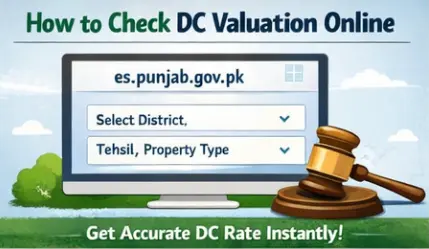
Here is the step-by-step process to check the DC valuation online:
Step 1: Visit the Official Portal Go to the Punjab e-stamp citizen portal at es.punjab.gov.pk or the Punjab Zameen e-stamp portal at es.punjab-zameen.gov.pk. Both are official government platforms.
Step 2: Navigate to DC Valuation On the portal homepage, look for the section labelled “Property DC Valuation” or “Valuation of Land DC Rate.” Click on it to open the valuation calculator.
Step 3: Enter Property Details The system will ask you to fill in the following fields:
- Urban or Rural area
- District
- Tehsil
- City / Town
- Revenue Circle
- Floor (Plot / Constructed / Apartment / Agricultural)
- Land Classification (Residential / Commercial)
- Property Area (in Marla, Kanal, or square feet)
Step 4: Get the DC Rate After submitting the details, the portal will display the applicable DC rate per Marla and the total DC value of the entered property area. Note this figure carefully — it will be the basis for all your transaction taxes.
Step 5: Verify Before Proceeding If the value you declared for the transaction is lower than the figure returned by the portal, the system will flag it. You must bring your declared value up to at least the DC-evaluated amount before proceeding with stamp generation.
How to Get an E-Stamp in Punjab: Step-by-Step Process
Once you have confirmed the DC valuation of your property, here is how to generate and obtain the e-stamp:
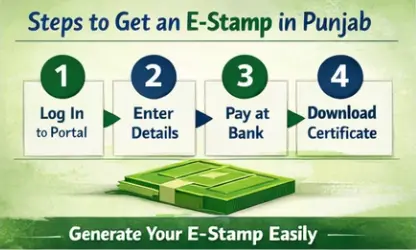
Step 1: Log into the E-Stamp Portal Visit the official PITB e-stamp portal. You can use the citizen portal directly or approach an authorized e-stamp vendor (registered lawyers, designated bank branches, or authorized agents).
Step 2: Enter Document and Party Details Fill in the type of document (e.g., sale deed, gift deed), the names and CNICs of both parties, the date of transaction, and the DC valuation figure for the property.
Step 3: Automatic Duty Calculation The system automatically calculates the applicable stamp duty and CVT based on the DC valuation tables. You do not need to manually compute these amounts.
Step 4: Generate the Challan Click “Generate Challan” to produce the payment challan (Form 32-A). Download and print this challan.
Step 5: Deposit Payment at a Designated Bank Take the printed challan to any branch of the National Bank of Pakistan (NBP), the Bank of Punjab, or another authorized scheduled bank. Deposit the stamp duty amount. You will receive a payment confirmation slip.
Step 6: Download the E-Stamp Certificate Once payment is confirmed (typically within 1–4 hours), return to the portal with your payment reference. The system generates the e-stamp certificate, which you can download and print on legal-sized paper. This certificate carries a unique stamp ID and QR code.
Step 7: Submit to Sub-Registrar Present the printed e-stamp certificate at the Sub-Registrar’s office along with your sale deed and other required documents. The registrar can verify the e-stamp instantly using the portal, making the process fast and fraud-proof.
Property Tax Punjab: What You Need to Know in 2025
Property tax in Punjab is an annual tax administered by the Excise and Taxation Department, Punjab on all taxable immovable properties. As of July 1, 2025, Punjab has completed a major reform, fully transitioning to a DC rate-based property tax system across the province.

Key Changes Under the 2025 Reform
The new system replaces the old Annual Rental Value (ARV) framework with a valuation model directly tied to DC rates. The practical implications are:
- Property tax is now calculated based on the government-assessed DC value of your property, making the process more transparent and predictable.
- A self-assessment portal is now available under the Excise and Taxation Department, Punjab, where property owners can calculate their own liability by entering their CNIC or Property ID.
- The reforms have brought over 600,000 previously untaxed properties into the tax net, bringing the total number of taxable units close to 2.5 million in the province.
- Property tax revenue in Punjab increased significantly in 2025, with the additional funds directed toward infrastructure, roads, and municipal services.
Who Is Exempt from Property Tax in Punjab?
The 2025 reforms include several important exemptions designed to protect lower-income and vulnerable groups. The following are generally exempt or receive significant relief:
- Residential properties below a specified DC-value threshold (targeting small homeowners)
- Properties owned by widows, persons with disabilities, and retired government employees (subject to income/asset conditions)
- Religious institutions and places of worship
- Government-owned properties used for public purposes
- Properties in newly upgraded Nagar Panchayats during the transition period
Always verify your specific exemption status on the official Excise and Taxation Department portal, as eligibility criteria can change with each financial year’s notification.
How to Pay Property Tax in Punjab Online
Property tax in Punjab can now be paid digitally through multiple channels:
- ePay Punjab app (available on Android and iOS): Search for “ePay Punjab” and pay directly using debit/credit card or mobile banking.
- Excise and Taxation Department portal: Log in with CNIC or Property ID, view your assessed tax, and generate an e-challan for payment.
- Designated bank branches: Any NBP branch or other authorized bank accepts property tax challans in person.
Frequently Asked Questions
Can I reduce the DC rate for my area? No. The DC rate is set by the government and represents the minimum official value for any property transaction. You cannot negotiate it down. You may, however, declare a higher transaction value if the actual market price exceeds the DC rate.
Is the e-stamp certificate accepted outside Punjab? Yes. The Punjab e-stamp certificate, being a legally issued government document with digital authentication, is accepted in courts and government offices across Pakistan.
What happens if I use a lower value than the DC rate on my property deed? The e-stamp portal will flag the discrepancy automatically. If a deed is registered on a value lower than the DC rate, it can create serious legal complications, including penalties, denial of registration, or challenges to the deed’s validity in court.
How often are DC rates updated? DC rates are updated periodically by the Revenue Department of Punjab, typically once a year or when significant market changes warrant a revision. Always check the latest rates on the official portal before completing any transaction.
Where is the official e-stamp portal for Punjab? The official portals are es.punjab.gov.pk (main citizen portal) and es.punjab-zameen.gov.pk. Avoid third-party websites that claim to generate e-stamps, as only officially designated portals and authorized vendors can issue legally valid e-stamp certificates.
Key Takeaways
The DC valuation system, the DC rate list, the e-stamp Punjab portal, and the property tax framework are all deeply interconnected. A property buyer or seller in Punjab who understands how these pieces fit together will avoid costly surprises at the registrar’s office and ensure their transaction is legally sound from day one.
The e-stamp system in particular has made Punjab’s property market significantly more transparent. The days of forged stamp papers and manual treasury visits are largely over. Today, a few clicks on the official portal can confirm exactly what your property is worth in government terms, what taxes you owe, and generate a tamper-proof legal document — all before you leave your home.
This article is based on publicly available guidelines from the Board of Revenue Punjab, the Punjab Information Technology Board (PITB), and the Excise and Taxation Department Punjab. For any specific transaction, consult a registered property lawyer or a qualified tax consultant familiar with the latest notifications issued by the Government of Punjab.