
Source: Finance Bill 2026 · FY2026-27 · Effective 1 July 2026 Published: June 2026 | primegroupofmarketing.com
Pakistan Budget 2026-27 | Real Estate Tax Updates
✅ Quick Answer
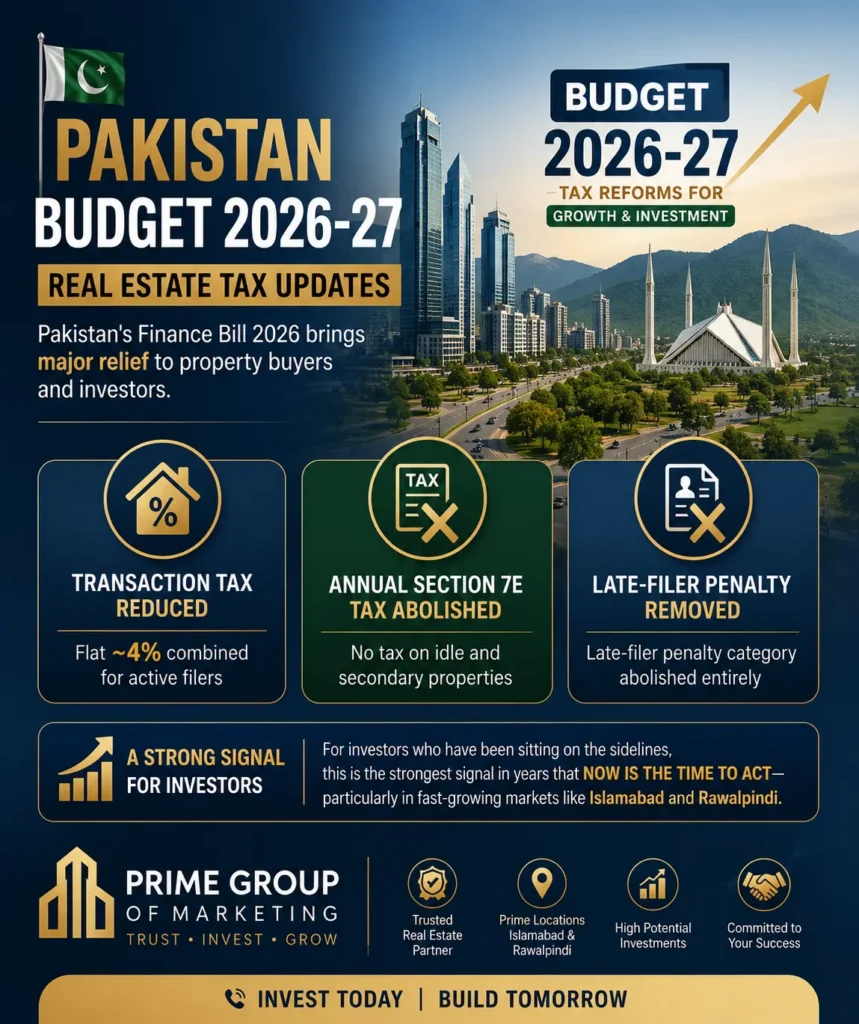
Pakistan’s Finance Bill 2026 cuts real estate transaction tax to a flat ~4% combined for active filers, abolishes the annual Section 7E tax on idle and secondary properties, and removes the late-filer penalty category entirely. For investors who have been sitting on the sidelines, this is the strongest signal in years that now is the time to act — particularly in fast-growing markets like Islamabad and Rawalpindi.
The Investor Who Waited Too Long
Three years ago, a client of ours was looking at a commercial plot in a developing sector of Islamabad. The price was right. The location was right. The only thing holding him back was the tax bill — at the time, transferring that property would have cost him close to 15% in combined buyer and seller-side taxes, plus an annual Section 7E charge because the plot’s value crossed PKR 25 million.
He waited.
Three years later, that same plot has appreciated significantly. He is now looking at a similar investment opportunity, except the entry price is far higher — and ironically, the tax environment that scared him off has just been dismantled.
This is the story we hear constantly in Pakistani real estate: good investors delay good decisions because the tax math doesn’t make sense — until the math changes and the opportunity has already moved on.
Pakistan Budget 2026-27 just changed the math. Significantly. And this time, the opportunity is still here.
What Pakistan Budget 2026-27 Actually Means for Investors
Let’s skip the legal jargon and talk about what matters to someone deciding whether to put money into property right now.
The Finance Bill 2026, effective 1 July 2026, makes real estate in Pakistan meaningfully cheaper to buy, sell, and hold — if you are a registered tax filer. Here is the investor-relevant summary:
| What You Care About | Old Reality | New Reality (FY2026-27) |
|---|---|---|
| Cost to buy (advance tax) | 1.5%–2.5% sliding scale | Flat 1.25% |
| Cost to sell (advance tax) | 4.5%–5.5% sliding scale | Flat 2.75% |
| Annual tax just for holding property | Up to 1% of value every year (Section 7E) | Abolished |
| Penalty for filing your return late | Elevated “late filer” rates | Category removed — same as active filer |
| Tax on inherited property sales | Calculated from decades-old purchase price | Calculated from value at date of inheritance |
For an investor with PKR 1 crore to deploy, the old system cost roughly PKR 6–8 lakh in combined transaction tax over a typical buy-and-hold-and-sell cycle. Under the new system, that drops to approximately PKR 4 lakh — a meaningful difference that goes straight back into your returns.
Why This Matters More Than the Headlines Suggest
Most coverage of Budget 2026-27 focuses on the percentages. But the real story for investors is about behavior change in the market.
When transaction costs are high, three things happen:
- Fewer people sell, because holding feels cheaper than transacting
- Fewer people buy formally, because the entry cost eats into returns
- Prices stagnate in mid-tier markets because liquidity dries up
When transaction costs fall — as they have now — the opposite happens. Documented buying and selling activity increases. More listings come to market. More buyers can justify entering. Price discovery becomes more active, which is good for sellers and good for genuine investors who understand value.
This is exactly the pattern the Finance Bill is designed to create, and it tends to benefit early movers most. Investors who transact in the first 12–18 months after a tax reform like this typically capture the best combination of lower entry tax and pre-momentum pricing.
Section 7E Abolition: The Single Biggest Win for Portfolio Investors
If you hold more than one property — which describes most serious real estate investors — Section 7E was quietly eating into your returns every single year.
How It Worked
Any property valued above PKR 25 million was treated as generating “deemed income” equal to 5% of its value, taxed at 20%. The practical result was a 1% annual tax on the property’s value, whether or not it earned a single rupee.
The Investor Impact
Consider a portfolio of plots in Islamabad and Rawalpindi worth a combined PKR 1.5 crore, with individual holdings crossing the 25M threshold.
Under the old rules: approximately PKR 1.5 lakh per year in Section 7E tax — purely for holding, with no income generated.
Under Finance Bill 2026: PKR 0.
For an investor holding land for medium-term appreciation — the standard strategy in markets like Bahria Town, DHA, and CDA sectors — this single change improves net annual returns substantially. Land banking, which had become a tax liability under the old system, becomes a viable strategy again.
The Federal Constitutional Court declared Section 7E unconstitutional in May 2026, and the Finance Bill 2026 has now formally written that abolition into law.
What This Means If You’re Buying
If you’re an active filer purchasing property after 1 July 2026, your advance tax under Section 236K drops to a flat 1.25% of fair market value — down from a tiered system that charged up to 2.5% on higher-value transactions.
Practical example:
| Property Value | Old Buyer Tax (approx.) | New Buyer Tax | You Save |
|---|---|---|---|
| PKR 75 lakh | PKR 1,50,000 (2%) | PKR 93,750 | PKR 56,250 |
| PKR 2 crore | PKR 4,00,000 (2%) | PKR 2,50,000 | PKR 1,50,000 |
| PKR 5 crore | PKR 11,25,000 (2.25%) | PKR 6,25,000 | PKR 5,00,000 |
On larger commercial or plot investments, this is real money — money that can go toward a better location, a larger unit, or simply stay in your pocket.
⚠️ One thing to verify before you transact: the Finance Bill’s Salient Features document mentions a 1.5% rate, while the operative First Schedule text confirms 1.25%. The operative legal text takes precedence, but always check the final gazette notification or ask your consultant to confirm before signing.
What This Means If You’re Selling
Sellers benefit even more dramatically. Section 236C drops from a sliding scale of 4.5%–5.5% to a flat 2.75%.
Practical example:
| Sale Value | Old Seller Tax (approx.) | New Seller Tax | You Save |
|---|---|---|---|
| PKR 75 lakh | PKR 3,37,500 (4.5%) | PKR 2,06,250 | PKR 1,31,250 |
| PKR 2 crore | PKR 10,00,000 (5%) | PKR 5,50,000 | PKR 4,50,000 |
| PKR 5 crore | PKR 27,50,000 (5.5%) | PKR 13,75,000 | PKR 13,75,000 |
If you’ve been holding a property and waiting for the “right time” to sell, the reduced exit cost alone may shift your calculation. Combined with potentially improved buyer demand from the lower entry tax, sellers are in a noticeably stronger position from July 2026 onward.
⚠️ Remember: Capital Gains Tax is separate from Section 236C. If your property was purchased after July 1, 2024, a flat 15% CGT applies to your profit. Properties purchased earlier still benefit from the older reducing-slab CGT structure. Factor this into your net return calculation.
Late-Filer Penalty: Quietly Removed
This change gets less attention, but it matters for a lot of people.
Previously, Pakistan’s tax system had three tiers for property transactions: active filer, late filer (elevated rates), and non-filer (highest rates). If you filed your tax return a little late in any given year, you paid more on your next property transaction — sometimes significantly more.
Finance Bill 2026 removes the late-filer category entirely. Now there are only two tiers: filer and non-filer.
If you’ve been classified as a late filer in the past, you now qualify for the same rates as any other active filer — 1.25% buying, 2.75% selling — as long as you appear on the FBR Active Taxpayer List (ATL) when you transact.
📌 Check your status in 30 seconds at fbr.gov.pk/verifyAtl using your CNIC. This single check determines whether you pay the new low rates or the much higher non-filer rates.
A Quiet But Important Change: Inherited Property
If you’ve inherited land or a house from a parent or relative, this change directly affects your tax bill when you eventually sell.
Old rule: Capital Gains Tax on inherited property was calculated using the original purchase price — sometimes from decades ago — meaning you paid tax on appreciation that happened entirely under someone else’s ownership.
New rule: The cost basis is now the property’s Fair Market Value at the date of the deceased’s death. You only pay CGT on the gain that occurred during your ownership.
Example:
A father purchased a plot in 1998 for PKR 3 lakh. He passed away in 2025, when the plot’s FMV was PKR 60 lakh. His son inherits it and sells it in 2027 for PKR 68 lakh.
Old calculation: Gain = 68L − 3L = PKR 65 lakh taxed New calculation: Gain = 68L − 60L = PKR 8 lakh taxed
This is a major fairness correction, especially relevant for families managing inherited real estate in Islamabad, Rawalpindi, and across Pakistan. If you’re settling an estate, get a documented FMV valuation as close to the date of death as possible — it becomes your tax baseline going forward.
The Real Question: Is Now a Good Time to Invest?
We get asked this constantly, and the honest answer is: it depends on your goals, but the tax environment has stopped being an obstacle.
Here’s how we’d frame the decision:
Buy now if:
- You are an active filer (or can become one quickly)
- You have identified a specific property or project with genuine fundamentals — location, development stage, access to amenities
- You can complete the transaction after 1 July 2026 to access the new rates
- You are thinking medium to long-term (3+ years), where the abolition of Section 7E compounds in your favor every year you hold
Wait and reassess if:
- You are not yet on the FBR Active Taxpayer List — the new rates do not help non-filers
- You are purchasing purely speculatively without a location or project thesis
- You need to verify final gazette rates before committing large capital
Sell now if:
- You’ve been holding a property primarily because the exit tax felt too high — that calculation has improved meaningfully
- Your property has appreciated and you’re ready to redeploy capital elsewhere
- You’ve been paying Section 7E annually on a high-value, low-income property — that burden disappears regardless, but selling lets you reallocate capital to something more productive
What Smart Investors Are Doing Right Now
Based on what we’re seeing across our client base in Islamabad and Rawalpindi, three patterns are emerging:
1. Portfolio consolidation. Investors with multiple smaller plots are consolidating into fewer, higher-quality holdings — since the Section 7E penalty for holding multiple high-value assets is gone, but smart capital allocation still wins long-term.
2. Renewed interest in commercial plots. Commercial property in growth corridors had become less attractive when 7E and high transaction taxes combined. With both reduced, commercial investment interest is picking back up, particularly in newer CDA and DHA sectors.
3. Overseas Pakistani re-engagement. With CVT on foreign assets abolished and buyer-side tax dropping to 1.25%, overseas Pakistanis who paused their Pakistan investment plans during the high-tax years are re-evaluating. The combination of lower entry cost and no annual foreign-asset penalty makes a meaningful difference for NRP investors balancing assets across multiple countries.
Common Mistakes to Avoid During This Transition
Don’t assume the rates apply before July 1, 2026. The Finance Bill takes effect from the new fiscal year. Transactions completed before then are governed by the old rates.
Don’t skip your ATL check. The entire benefit of this reform is built around being an active filer. If you’re not on the list, none of these reduced rates apply to you.
Don’t ignore Capital Gains Tax. Lower advance tax under 236C does not mean lower overall tax. CGT is calculated separately and can be substantial depending on your purchase date and profit margin.
Don’t rely solely on the Salient Features summary. As noted above, there’s a known discrepancy between the Salient Features document (1.5%) and the operative First Schedule (1.25%) for Section 236K. Always confirm with the final notified text or a qualified consultant.
Don’t transact informally to “save” on taxes. With rates this low for filers, the incentive to use undocumented or power-of-attorney-based transactions has weakened considerably — and the legal and resale risks of informal transactions remain just as real as before.
Comparing Your Options: Filer vs Non-Filer vs Informal Transaction
| Approach | Tax Cost | Legal Security | Resale Value | Recommended? |
|---|---|---|---|---|
| Active filer, documented transaction | ~4% combined | Full legal protection | Clean title, easy resale | ✅ Yes |
| Non-filer, documented transaction | 10%+ combined | Full legal protection | Clean title, easy resale | ⚠️ Only if no other option |
| Informal/power-of-attorney transaction | Minimal upfront | Weak legal standing | Difficult resale, disputes common | ❌ Not recommended |
With the tax gap between filers and informal arrangements narrowing this much, there is very little remaining justification for cutting corners on documentation. The math now favors doing things properly.
Frequently Asked Questions
Is now a good time to invest in Pakistani real estate? For active tax filers, Budget 2026-27 has removed several of the biggest cost barriers — high transaction tax and the annual Section 7E charge. Combined with continued urban growth in Islamabad and Rawalpindi, the fundamentals support investment for those with a clear location and project strategy.
How much will I save in tax under the new budget? For an active filer, combined buyer and seller-side transaction tax drops from roughly 6–8% to approximately 4%. Section 7E’s annual 1% charge on properties above PKR 25 million is also eliminated entirely.
Do these new tax rates apply to overseas Pakistanis? Yes. Overseas Pakistanis who qualify as non-residents (spending fewer than 183 days per year in Pakistan) can access filer-equivalent rates under Sections 236C and 236K, and benefit from the abolition of CVT on foreign assets.
What is the best type of property to invest in right now? This depends on your goals, but commercial plots and developed residential sectors in growth corridors around Islamabad and Rawalpindi are seeing renewed interest now that holding costs (Section 7E) have dropped.
Should I sell my property now or wait? If you’ve been delaying a sale due to high exit tax, the reduced Section 236C rate (2.75% vs the old 4.5%–5.5%) significantly improves your net proceeds. Combine this with your specific Capital Gains Tax situation before deciding.
What happens if I’m not on the FBR Active Taxpayer List? You will not benefit from the reduced rates under Finance Bill 2026. Non-filers continue to face significantly higher transaction taxes. Check your status at fbr.gov.pk/verifyAtl and file your return if needed before transacting.
Is Section 7E really gone for good? Yes. The Federal Constitutional Court ruled it unconstitutional in May 2026, and Finance Bill 2026 formally removes it from law. Barring future legislative changes, it no longer applies.
Does the new tax rate apply to commercial property too? Yes, Sections 236C and 236K apply to both residential and commercial property transactions. Commercial investors benefit particularly from the Section 7E abolition, since many commercial holdings exceeded the PKR 25 million threshold.
How does inherited property get taxed now? Capital Gains Tax on inherited property is now calculated using the Fair Market Value at the date of the deceased’s death, rather than their original purchase price — meaning heirs are taxed only on gains made during their own ownership period.
What’s the catch with the new tax rates? There is a known drafting discrepancy in Section 236K between the Salient Features summary (1.5%) and the operative legal text (1.25%). Confirm the final rate from the official gazette notification once issued, and remember Capital Gains Tax still applies separately.
Talk to Prime Group of Marketing Before You Decide
Tax reform creates opportunity, but only for investors who move with accurate information and the right property strategy. Whether you’re buying your first investment plot, expanding a portfolio, or evaluating an inherited property, understanding your real numbers under Finance Bill 2026 is the first step.
Prime Group of Marketing works with buyers, sellers, and overseas Pakistani investors across Islamabad and Rawalpindi’s most active real estate corridors. Our team can walk you through specific project opportunities, current pricing, and exactly what your transaction will cost under the new rules.
- 🏘️ Explore current project opportunities in Islamabad & Rawalpindi
- 📊 Get a personalized cost breakdown for buying or selling under Finance Bill 2026
- 🌍 Investment guidance for overseas Pakistani clients
- 📞 Book a free consultation with our investment team
Sources
- Business Recorder — Real estate sector tax cuts, Budget 2026-27
- Profit by Pakistan Today — Federal Constitutional Court declares Section 7E unconstitutional, May 2026
- Bloom Pakistan — IMF agrees to property tax cuts in Budget 2026-27
- FBR Active Taxpayer List — fbr.gov.pk/verifyAtl
⚠️ Disclaimer: This article reflects provisions confirmed in the Finance Bill 2026 as presented on 12 June 2026. Rates become legally operative only after presidential assent and official FBR gazette notification. A drafting discrepancy exists in Section 236K (1.5% in Salient Features vs 1.25% in the operative First Schedule) — the operative text governs unless corrected before enactment. This article is for informational purposes only and does not constitute tax or legal advice. Consult a qualified tax advisor before making investment decisions. Last updated: June 2026.